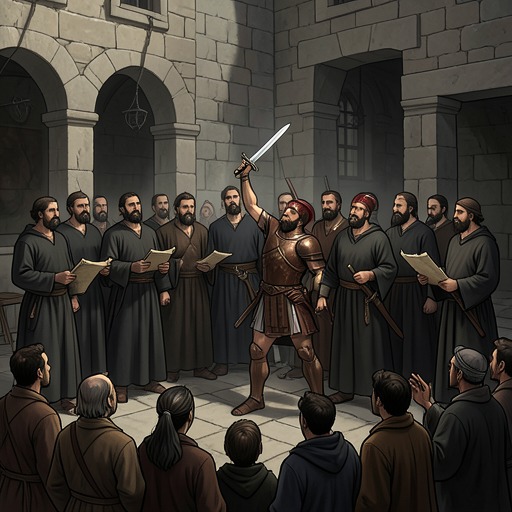
Claudius Lysias
Acts of the ApostlesClaudius Lysias is the Roman tribune whose decisions repeatedly determine whether Paul remains exposed to danger or is carried under guard toward Caesarea. He becomes a consequential intermediary between Paul, the Jerusalem crowd, and the Roman administration: his soldiers interrupt an attempt to kill Paul, his investigation turns on Paul’s citizenship, and his escort frustrates a conspiracy. Yet the narrative does not make him an uncomplicated champion of justice. He initially orders Paul flogged, and his later letter revises the sequence of events in a way that casts his own conduct favorably.
Identity and Position
The book identifies the tribune by name only when he writes to Felix about Paul’s transfer to Caesarea. Claudius Lysias is a Roman officer with a cohort of roughly six hundred soldiers, and his role gives him practical control over Paul’s custody and movement. He can intervene in the crowd’s violence, question Paul, direct an attempted flogging, and arrange a heavily guarded journey to the governor. These powers make him a pivotal official in the narrative, though not its final judge: he sends Paul onward so Felix can examine the charges.
His position also places him within the story’s uneven picture of Roman power. Roman authorities protect Paul from immediate violence and provide the means by which he can continue toward Rome. At the same time, the threat of flogging shows that the machinery of Roman custody can itself endanger him. The narrative’s contrast is therefore not between a wholly just empire and wholly unjust opponents, but between particular actions and institutions whose effects shift with a person’s status and circumstances.
The Arrest and Threat of Flogging
When the Jerusalem crowd turns violent, the tribune and soldiers reach Paul and take him into custody for questioning. Their intervention saves him from the mob, even as the soldiers must continue to protect him while the crowd cries for his death. The account presents Roman arrest as the immediate means of rescue from vigilante violence. Its portrayal also sharpens a polemical contrast between the Roman officers and the hostile crowd; the book’s commentary warns that this contrast reflects Luke’s negative generalization about many Jewish people and should not be treated as a neutral description of Jewish communities.
The protection is conditional. After the crowd renews its cries against Paul, the tribune orders him taken to the barracks and flogged to discover why the people are shouting. Paul is tied with thongs, and the flogging is about to begin when he asks the centurion whether it is lawful to flog an uncondemned Roman citizen. The question interrupts the procedure and changes the balance of power. The tribune has acted as Paul’s immediate protector from the crowd, but has also placed him on the verge of an unauthorized punishment.
Citizenship and the Reversal of Authority
Paul’s disclosure that he is a Roman citizen prompts the centurion to alert the tribune. The officer recognizes that he and the tribune could face punishment for flogging a citizen, and the planned beating stops. The reversal is pointed: Paul is physically bound, yet his inherited citizenship gives him a legal standing that outranks the tribune’s purchased citizenship. A man under the tribune’s control can now affect the tribune’s own security and decisions.
The narrative makes citizenship more than a personal credential. Roman citizenship belonged to a restricted social class and carried protections unavailable to ordinary residents, including protection from punishment without formal trial and the right to appeal to Caesar. The book interprets Paul’s status as a means through which divine providence uses Roman institutions to preserve him and facilitate his journey. It also stresses the ethical limit of that arrangement: justice of this kind should be available to everyone, not only to those with privileged standing.
The Plot and the Transfer to Caesarea
A plot to kill Paul comes to light through a messenger. Paul’s sister’s son learns of the conspiracy, and Paul asks a centurion to bring the young man to the tribune. Claudius Lysias hears the report privately; after the young man discloses the plan, the tribune orders him to keep the matter quiet. The episode makes the tribune a receiver of information as well as a commander. The warning reaches him through people who are not the principal decision-makers, and it gives him the opportunity to act before the conspiracy can succeed.
Claudius Lysias responds by arranging Paul’s transfer to Caesarea, where Felix can question him in a safer setting. He assembles an escort of 470 foot soldiers, riders, and soldiers equipped with spears. The scale of the party conveys how seriously the danger is treated and makes the journey itself a form of protection. The book contrasts this Roman guard with the assassins waiting in Jerusalem, while its interpretation cautions readers to recognize how the contrast participates in Luke’s negative depiction of Jewish leaders and conspirators.
The tribune’s letter to Felix summarizes how Paul came to his attention, his attempt to determine the charges, and his conclusion that the dispute concerned Torah rather than Roman law. He sends Paul to the governor and orders the accusers to appear there, placing the dispute before an official who can examine it. The letter gives Claudius Lysias a formal role in the legal process, but it also becomes evidence of how he presents his own conduct.
Self-Presentation and Narrative Significance
The book says Claudius Lysias revises his account of what happened so as to present himself positively and avoid punishment for mistreating a citizen. His communication is therefore not simply a transparent record: it is an official version shaped by self-interest. That detail complicates the earlier image of the tribune as Paul’s rescuer. His decisions protect Paul, but the narrative also shows him managing the account of his own responsibility once the danger of legal consequences becomes real.
Claudius Lysias’s trajectory turns on a recurring instability: Roman procedure can threaten Paul, then shield him; the tribune can exercise coercive power, then respond to the citizen’s superior legal status; and the officer who arranges safe passage also edits the story of his actions. In this way, he embodies the ambivalence of Roman authority in Acts. The system supplies Paul with a guarded route toward Caesarea and, ultimately, Rome, but its protections are bound to hierarchy, and the official record remains vulnerable to the interests of the person who writes it.